Lecture 2

Mastering Prompts

This course

Lecture 2Mastering Prompts
Lecture 3Operationalizing
prompts
Lecture 4Building powerful
workflows
Lecture 5Breaking out from
our Chatbot
  • Generate the optimal prompt
  • Prompts for repetitive tasks

Concepts & exercises

Concept8
Exercise11
White slide: Learn a concept
Blue slide: Apply it in ChatGPT
Mastering Prompts
  • 1.Prompt Engineering
  • 2.Structure of a prompt
  • 2.1.Task
  • 2.2.Context
  • 2.3.Exemplar, Persona, Format, Tone
  • 2.4.Exercises
  • 3.Improving the prompt: Four-iteration method
  • 4.Advanced Prompting techniques
  • 4.1.Chain Prompting
  • 4.2.Few-shot prompting
  • 4.3.Meta-Prompting
  • 4.4.Self-Critique & Reflection
  • 4.5.ReAct
  • 5.Brainstorm & verify
  • 5.1.The council
  • 5.2.Red-team
  • 5.3.Parallel answers
  • 5.4.Chain-of-verification
  • 5.5.Step back
  • 5.6.AI as judge
  • 5.7.Answer from sources
  • 5.8.Tree of thoughts
  • 5.9.Try, reflect, retry
  • 5.10.Make many, pick one
  • 5.11.Say “I don’t know”
  • 6.Models

What is a prompt?

  • Give an LLM specific instructions to:
    • Receive information
    • Achieve outcome
Text
Images
Videos
Sound
Mastering Prompts
  • 1.Prompt Engineering
  • 2.Structure of a prompt
  • 2.1.Task
  • 2.2.Context
  • 2.3.Exemplar, Persona, Format, Tone
  • 2.4.Exercises
  • 3.Improving the prompt: Four-iteration method
  • 4.Advanced Prompting techniques
  • 4.1.Chain Prompting
  • 4.2.Few-shot prompting
  • 4.3.Meta-Prompting
  • 4.4.Self-Critique & Reflection
  • 4.5.ReAct
  • 5.Brainstorm & verify
  • 5.1.The council
  • 5.2.Red-team
  • 5.3.Parallel answers
  • 5.4.Chain-of-verification
  • 5.5.Step back
  • 5.6.AI as judge
  • 5.7.Answer from sources
  • 5.8.Tree of thoughts
  • 5.9.Try, reflect, retry
  • 5.10.Make many, pick one
  • 5.11.Say “I don’t know”
  • 6.Models

Your prompt

  • Objective: Create a prompt that generates every meal for your week, on one page.
✎ editable — ↑ runs it in ChatGPT

Prompt structure

  • A prompt has six components

Prompt structure

Plastic-Covered Toast
Elevates Fish Taste
Each highlighted letter is a component. Which six?
Persona
Context
Task
Exemplar
Format
Tone

Six components of a prompt

More
important
Optional
Task
Context
Exemplar
Persona
Format
Tone
Context
Task
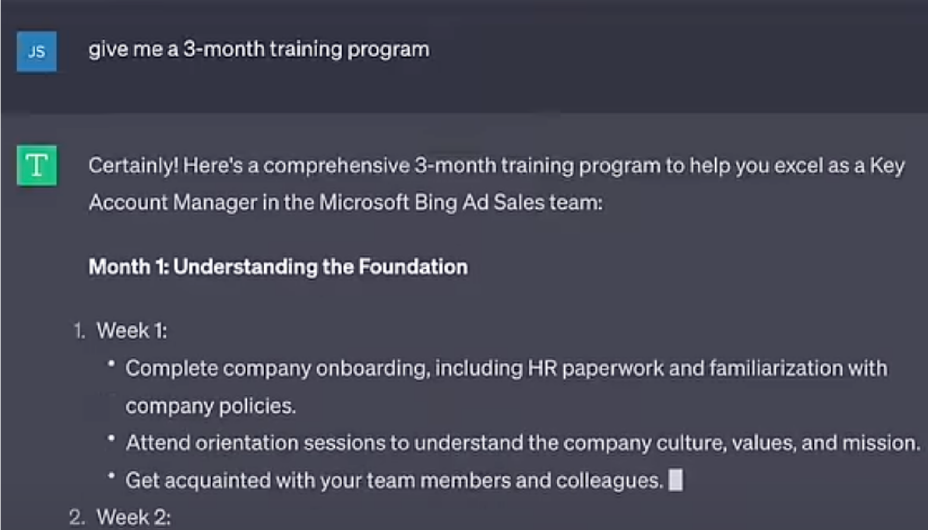
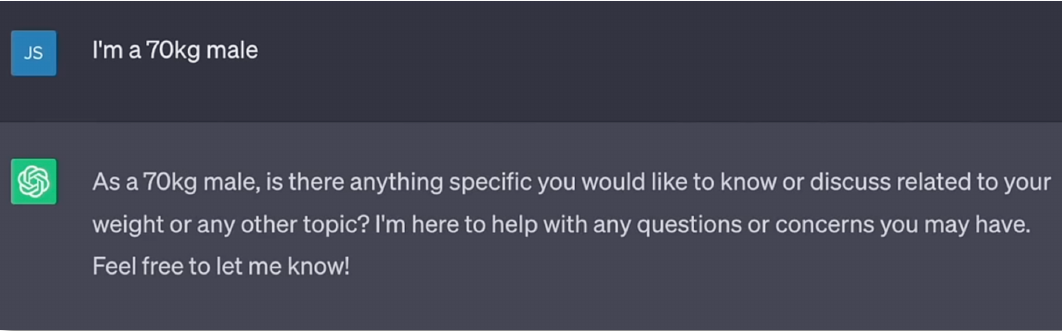
I’m a 70kg male, give me a 3-month training program
Why does task beat context?

Six components of a prompt

More
important
Optional
TaskContextExemplarPersonaFormatTone
Give me a 3-month training
program
Task, no context
I am a 70kg male
Context, no task

Six components of a prompt

More
important
Optional
TaskContextExemplarPersonaFormatTone
Give me a 3-month training
program
I am a 70kg male

Six components of a prompt

More important
Optional
Task
Mandatory
Context
Important
Exemplar
Nice to have
Persona
Nice to have
Format
Nice to have
Tone
Nice to have
Note
A good prompt does not need all six.

Syntax order

  • Build a prompt in this order:
Task+Context+Exemplar+Persona+Format+Tone
Mastering Prompts
  • 1.Prompt Engineering
  • 2.Structure of a prompt
  • 2.1.Task
  • 2.2.Context
  • 2.3.Exemplar, Persona, Format, Tone
  • 2.4.Exercises
  • 3.Improving the prompt: Four-iteration method
  • 4.Advanced Prompting techniques
  • 4.1.Chain Prompting
  • 4.2.Few-shot prompting
  • 4.3.Meta-Prompting
  • 4.4.Self-Critique & Reflection
  • 4.5.ReAct
  • 5.Brainstorm & verify
  • 5.1.The council
  • 5.2.Red-team
  • 5.3.Parallel answers
  • 5.4.Chain-of-verification
  • 5.5.Step back
  • 5.6.AI as judge
  • 5.7.Answer from sources
  • 5.8.Tree of thoughts
  • 5.9.Try, reflect, retry
  • 5.10.Make many, pick one
  • 5.11.Say “I don’t know”
  • 6.Models
TaskContextExemplarPersonaFormatTone
1.State the objective in one sentence
2.Use action verbs
Summarize
Classify
Generate
Compare
3.Avoid vague goals (“talk about…”).
4.Name constraints: length, depth, rigor.
5.List subtasks explicitly, in order.
✎ editable — ↑ runs it in ChatGPT
> Generate a 3-month training program
TaskContextExemplarPersonaFormatTone
1.State the objective in one sentence
2.Use action verbs
Summarize
Classify
Generate
Compare
3.Avoid vague goals (“talk about…”).
4.Name constraints: length, depth, rigor.
5.List subtasks explicitly, in order.
✎ editable — ↑ runs it in ChatGPT
> Generate a 3-month training program for me to follow. Focus on compound exercises that work at least three muscle groups at once
Show a strong version
> Can you talk about 3-month training programs?
TaskContextExemplarPersonaFormatTone
1.State the objective in one sentence
2.Use action verbs
Summarize
Classify
Generate
Compare
3.Avoid vague goals (“talk about…”).
4.Name constraints: length, depth, rigor.
5.List subtasks explicitly, in order.
✎ editable — ↑ runs it in ChatGPT
1. Generate a 3-month training program for me to follow 2. Create a numbered list of each exercise 3. For each exercise in that list, classify the muscles worked

Your prompt

  • Objective: A prompt that generates a week of meal recipes on one page.
  • Work on developing:
  • Task
✎ editable — ↑ runs it in ChatGPT
Mastering Prompts
  • 1.Prompt Engineering
  • 2.Structure of a prompt
  • 2.1.Task
  • 2.2.Context
  • 2.3.Exemplar, Persona, Format, Tone
  • 2.4.Exercises
  • 3.Improving the prompt: Four-iteration method
  • 4.Advanced Prompting techniques
  • 4.1.Chain Prompting
  • 4.2.Few-shot prompting
  • 4.3.Meta-Prompting
  • 4.4.Self-Critique & Reflection
  • 4.5.ReAct
  • 5.Brainstorm & verify
  • 5.1.The council
  • 5.2.Red-team
  • 5.3.Parallel answers
  • 5.4.Chain-of-verification
  • 5.5.Step back
  • 5.6.AI as judge
  • 5.7.Answer from sources
  • 5.8.Tree of thoughts
  • 5.9.Try, reflect, retry
  • 5.10.Make many, pick one
  • 5.11.Say “I don’t know”
  • 6.Models
TaskContextExemplarPersonaFormatTone
  • Give just enough background so the answer fits reality
  • Hardest component to get right
    • Limitless possibilities
    • Hard to know what info to give.
TaskContextExemplarPersonaFormatTone
  • Good context has four things
  1. User background
  2. What does success look like
  3. Environment/constraints
  4. Assets
age, role, experience
goals
time, budget, tools, schedule
data, websites, templates
TaskContextExemplarPersonaFormatTone
  • Good context has four things
  1. User background
  2. What does success look like
  3. Environment/constraints
  4. Assets
✎ editable — ↑ runs it in ChatGPT
> I’m a 70kg male, looking to put on 5 kilograms of muscle mass over the next three months. I only have time to go to the gym twice a week, and for 1 hour each session. I am attaching my results from my latest physical examination.
TaskContextExemplarPersonaFormatTone
  • Tips:
    • Prefer numbers over adjectives
    • Omit facts that don’t change the output.
“5 kg in 3 months”vs.“lose some weight soon”

Your prompt

  • Objective: Create a prompt that generates every meal for your week, on one page.
  • Work on developing:
  • Task ✅
  • Context
✎ editable — ↑ runs it in ChatGPT
Mastering Prompts
  • 1.Prompt Engineering
  • 2.Structure of a prompt
  • 2.1.Task
  • 2.2.Context
  • 2.3.Exemplar, Persona, Format, Tone
  • 2.4.Exercises
  • 3.Improving the prompt: Four-iteration method
  • 4.Advanced Prompting techniques
  • 4.1.Chain Prompting
  • 4.2.Few-shot prompting
  • 4.3.Meta-Prompting
  • 4.4.Self-Critique & Reflection
  • 4.5.ReAct
  • 5.Brainstorm & verify
  • 5.1.The council
  • 5.2.Red-team
  • 5.3.Parallel answers
  • 5.4.Chain-of-verification
  • 5.5.Step back
  • 5.6.AI as judge
  • 5.7.Answer from sources
  • 5.8.Tree of thoughts
  • 5.9.Try, reflect, retry
  • 5.10.Make many, pick one
  • 5.11.Say “I don’t know”
  • 6.Models
TaskContextExemplarPersonaFormatTone
  • Goal: Reduce guesswork by showing patterns.
✎ editable — ↑ runs it in ChatGPT
Match detail in following 1-day sample plan: Day 1: Upper Body - Push-ups (3 sets of 10), Dumbbell Press (3 sets of 8), Tricep Dips (3 sets of 10). Day 2: Lower Body - Squats (3 sets of 12), Lunges (3 sets of 12), Calf Raises (3 sets of 15). Create a similar structured plan for a beginner.
TaskContextExemplarPersonaFormatTone
  • Persona: who the model should “be”
  • Goal: Align reasoning and priorities.
TaskContextExemplarPersonaFormatTone
  • Tips:
  • Give a role, optionally a specialism
  • Add behavioral cues
  • Keep it realistic (roles that exist in the real world).
✎ editable — ↑ runs it in ChatGPT
>You are an experienced physical therapist….
✎ editable — ↑ runs it in ChatGPT
> You are a hiring manager looking to fill [position] on your team. Be demanding.

Your prompt

  • Objective: Create a prompt that generates every meal for your week, on one page.
  • Work on developing:
  • Task ✅
  • Context ✅
  • Write (if applicable):
  • Exemplar
  • Persona
✎ editable — ↑ runs it in ChatGPT
TaskContextExemplarPersonaFormatTone
  • How the answer should be structured
  • Goal:
  • Make output usable without rework
TaskContextExemplarPersonaFormatTone
  • Good format specifies:
  1. Container format
  2. Keys/columns/sections
  3. Order and unit
  4. If you’ll paste into tools
table, list, JSON, sections,
bullets
Kilograms, minutes
Excel, Word, SQL, Python
TaskContextExemplarPersonaFormatTone
✎ editable — ↑ runs it in ChatGPT
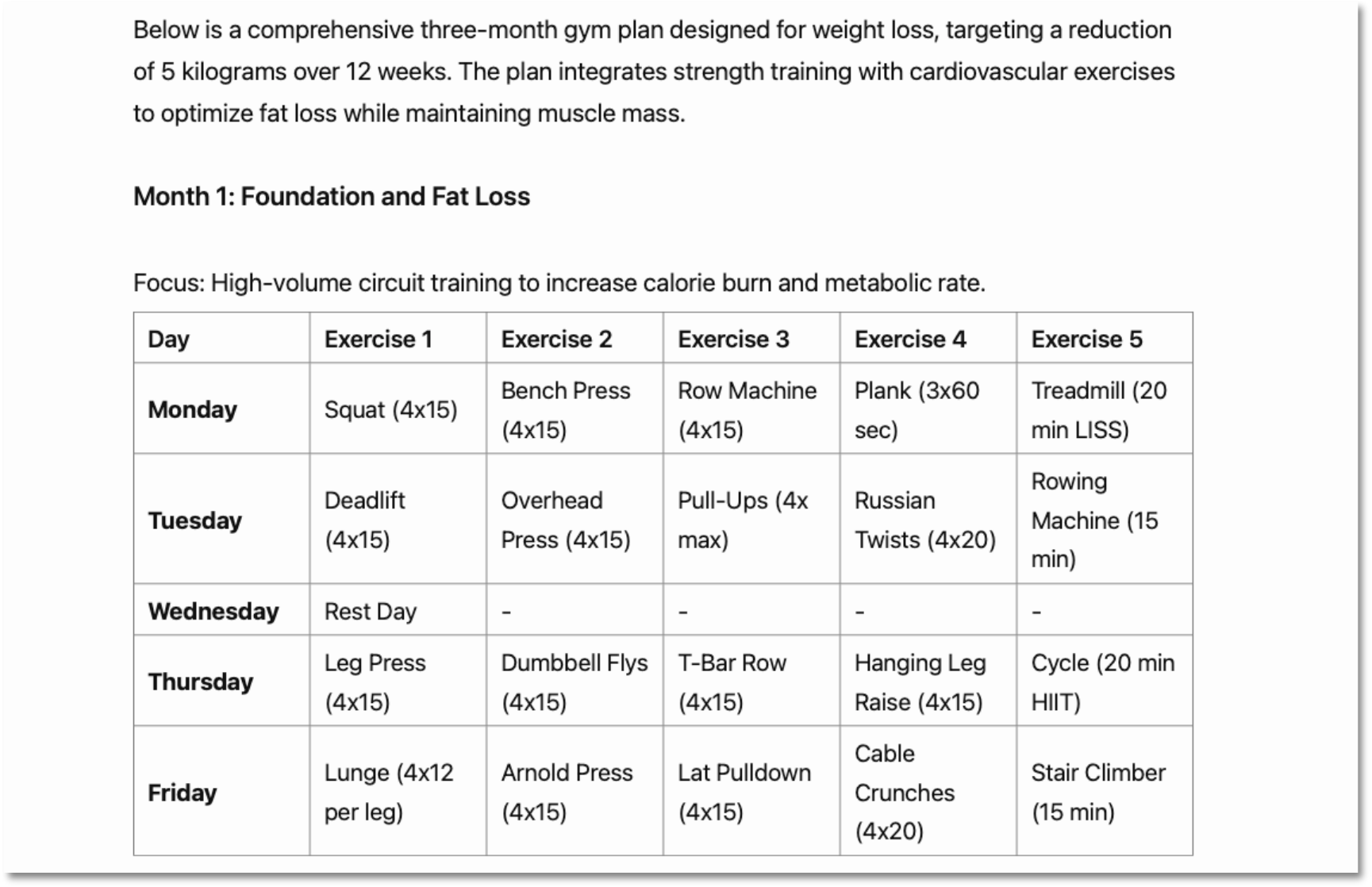
> Outline the exercises in a table from Monday to Friday, with each day as a row and each exercise as a column. Be concise
ChatGPT response: three-month gym plan with Monday–Friday exercise table
TaskContextExemplarPersonaFormatTone
  • How it should sound
  • Goal: Change the voice without rewriting the answer.
TaskContextExemplarPersonaFormatTone
  • Tips
  • Pick 2–3 tone adjectives
  • State audience level
  • Language & region
professional, concise, friendly,
technical, motivational.
beginner, intermediate, expert.
EN-US, EN-GB, ES-MX, etc

A good prompt

Persona
+
Context
+
Task
+
Exemplar
+
Format
+
Tone
You are a professional and encouraging coach, and I am a 70kg male looking to lose 5 kilograms over the next three months. I have 2 years of experience in weightlifting. Please create a comprehensive 3-month gym plan similar to those found on bodybuilding.com. Outline the exercises in a table from Monday to Friday, with each day as a row and each exercise set as a column. Be concise and use a professional, knowledgeable tone.

Your prompt

  • Objective: Create a prompt that generates every meal for your week, on one page.
  • Work on developing:
  • Task ✅
  • Context ✅
  • Write (if applicable):
  • Exemplar
  • Persona
  • Format
  • Tone
✎ editable — ↑ runs it in ChatGPT
Mastering Prompts
  • 1.Prompt Engineering
  • 2.Structure of a prompt
  • 2.1.Task
  • 2.2.Context
  • 2.3.Exemplar, Persona, Format, Tone
  • 2.4.Exercises
  • 3.Improving the prompt: Four-iteration method
  • 4.Advanced Prompting techniques
  • 4.1.Chain Prompting
  • 4.2.Few-shot prompting
  • 4.3.Meta-Prompting
  • 4.4.Self-Critique & Reflection
  • 4.5.ReAct
  • 5.Brainstorm & verify
  • 5.1.The council
  • 5.2.Red-team
  • 5.3.Parallel answers
  • 5.4.Chain-of-verification
  • 5.5.Step back
  • 5.6.AI as judge
  • 5.7.Answer from sources
  • 5.8.Tree of thoughts
  • 5.9.Try, reflect, retry
  • 5.10.Make many, pick one
  • 5.11.Say “I don’t know”
  • 6.Models

Exercise 2.1

  • Scenario: You work in procurement at Costco Canada. Every Monday, a one-page PDF called “banana_report” arrives with banana supply by supplier and province.
  • Your task: Write one ChatGPT prompt that turns this PDF into three deliverables, one at a time.
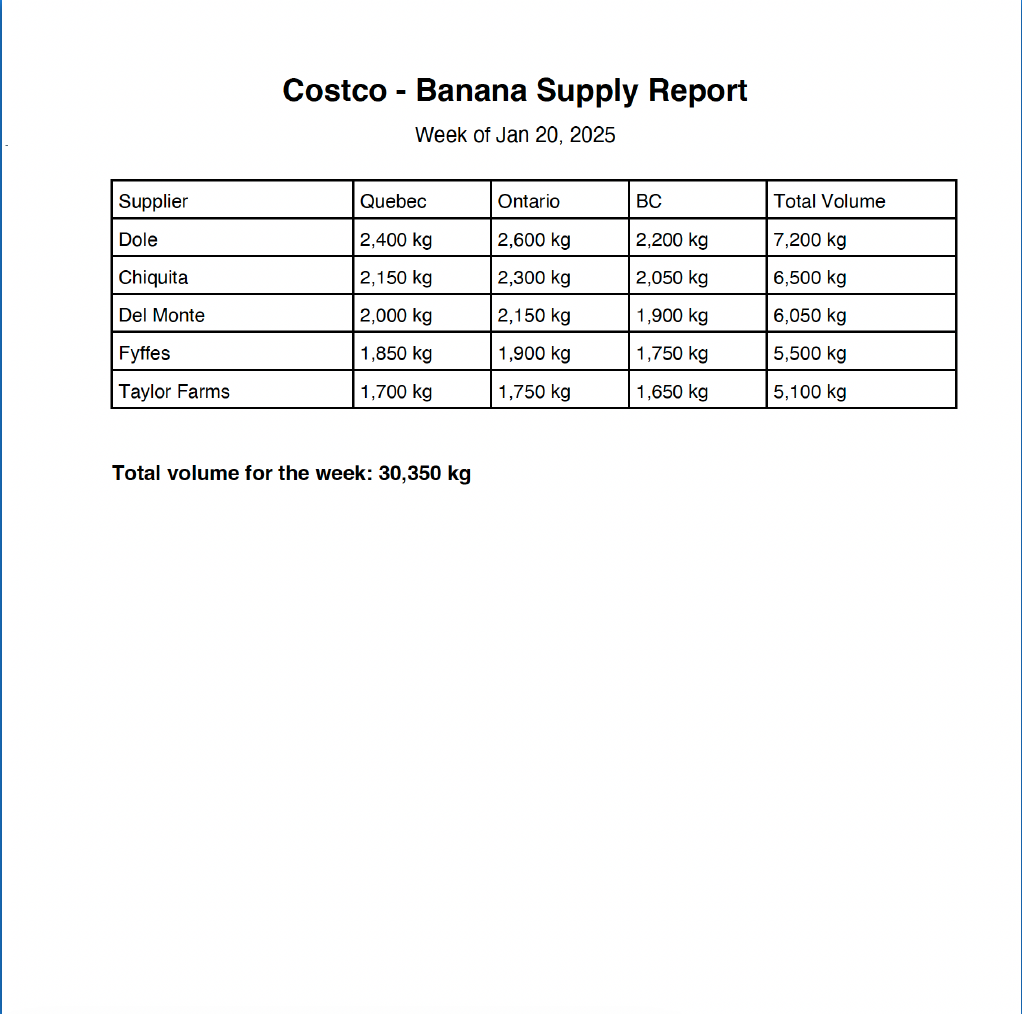
Costco - Banana Supply Report PDFOpen Exercise 2.1 →

Exercise 2.1

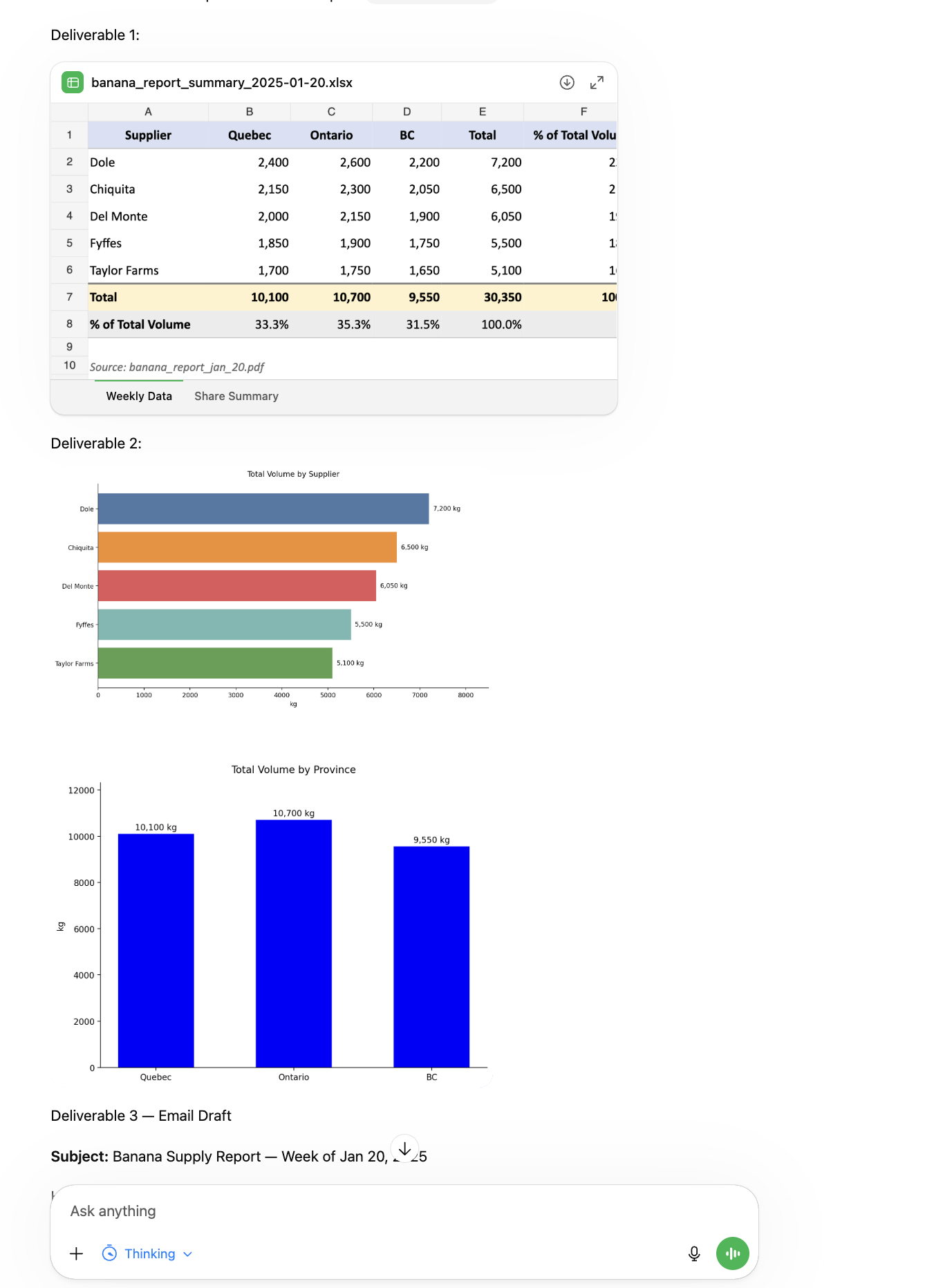
What to do: Write the prompt you’ll paste into ChatGPT with the PDF. It should produce three deliverables, in order.

Deliverable 1
Excel file

A downloadable .xlsx that goes beyond the raw PDF: all suppliers and provinces, plus percentage-share columns showing each supplier’s and each province’s share of total volume. Specify any formatting that matters.

Deliverable 2
Two charts

Two chart images from the Excel data:

  • Chart A: Horizontal bar chart, total volume by supplier. No grid lines. Exact values on the bars. A different color per supplier.
  • Chart B: Vertical bar chart, total volume by province (Quebec, Ontario, BC). No grid lines. Exact values on the bars. All bars blue.
Deliverable 3
Email draft

A short email to your supervisor with the week’s key numbers, noting the Excel file and charts are attached. You attach them; the prompt only writes the text.

Evaluation criteria: Does the prompt produce all three deliverables correctly on the first try? Could a teammate reuse it next Monday on a new PDF and get the same quality?
Open Exercise 2.1 →
10:00

My output

ChatGPT output: Deliverable 1 spreadsheet, Deliverable 2 charts, Deliverable 3 email draft
Mastering Prompts
  • 1.Prompt Engineering
  • 2.Structure of a prompt
  • 2.1.Task
  • 2.2.Context
  • 2.3.Exemplar, Persona, Format, Tone
  • 2.4.Exercises
  • 3.Improving the prompt: Four-iteration method
  • 4.Advanced Prompting techniques
  • 4.1.Chain Prompting
  • 4.2.Few-shot prompting
  • 4.3.Meta-Prompting
  • 4.4.Self-Critique & Reflection
  • 4.5.ReAct
  • 5.Brainstorm & verify
  • 5.1.The council
  • 5.2.Red-team
  • 5.3.Parallel answers
  • 5.4.Chain-of-verification
  • 5.5.Step back
  • 5.6.AI as judge
  • 5.7.Answer from sources
  • 5.8.Tree of thoughts
  • 5.9.Try, reflect, retry
  • 5.10.Make many, pick one
  • 5.11.Say “I don’t know”
  • 6.Models

Four-iteration method

Good prompt
80%
Good syntax
Persona
Context
Task
Exemplar
Format
Tone
20%
Refinement
Four-iteration method
20%
Refinement
Four-iteration method
Iterate to reach a winning prompt

Four-iteration method

1. Revisit
methods
2. Dissect prompt
3. Different
Phrasing or
Analogous task
4. Introduce
further constraints
1. Revisit
methods
2. Dissect prompt
3. Different Phrasing or Analogous task
4. Introduce further constraints
  • Revise the structure repeatedly
  • Revisit the six components
1. Revisit
methods
2. Dissect
prompt
3. Different Phrasing
or Analogous task
4. Introduce
further constraints
  • Split the prompt into short sentences,
    as bullets or numbers
  • Example:
> Summarize the key data points and information in this report. Then create visual graphs from the data and shorten the key information into bullets
1. Summarize key data points and information in this report. 2. Create visual graphs from the data you summarized. 3. Shorten key information you summarized into bullets.
1. Revisit
methods
2. Dissect
prompt
3. Different Phrasing
or Analogous task
4. Introduce
further constraints
If model struggles:
1.Rephrase request
2.Ask for a related task
Write a full 10-page syllabus for my course on AI and sustainability.
Act as a copyeditor:1.List the strengths of this essay2.List the weaknesses or potential biases.3.Conclude with a one-sentence overall evaluation of the study’s quality.
1. Revisit
methods
2. Dissect
prompt
3. Different Phrasing
or Analogous task
4. Introduce
further constraints
  • Narrow the solution space so answers are:
    • specific
    • useful
    • realistic
Create a Gym Program for me
Task with constraints
Create a 6-week gym training program for a beginner whose primary goal is hypertrophy (muscle gain).
Constraints:
Schedule: 3 sessions per week, 60 minutes each.
Equipment: barbells, dumbbells, cable machine only (no machines that require special setup).

Four-iteration method

1. Revisit
methods
2. Dissect prompt
3. Different
Phrasing or
Analogous task
4. Introduce
further constraints
Mastering Prompts
  • 1.Prompt Engineering
  • 2.Structure of a prompt
  • 2.1.Task
  • 2.2.Context
  • 2.3.Exemplar, Persona, Format, Tone
  • 2.4.Exercises
  • 3.Improving the prompt: Four-iteration method
  • 4.Advanced Prompting techniques
  • 4.1.Chain Prompting
  • 4.2.Few-shot prompting
  • 4.3.Meta-Prompting
  • 4.4.Self-Critique & Reflection
  • 4.5.ReAct
  • 5.Brainstorm & verify
  • 5.1.The council
  • 5.2.Red-team
  • 5.3.Parallel answers
  • 5.4.Chain-of-verification
  • 5.5.Step back
  • 5.6.AI as judge
  • 5.7.Answer from sources
  • 5.8.Tree of thoughts
  • 5.9.Try, reflect, retry
  • 5.10.Make many, pick one
  • 5.11.Say “I don’t know”
  • 6.Models

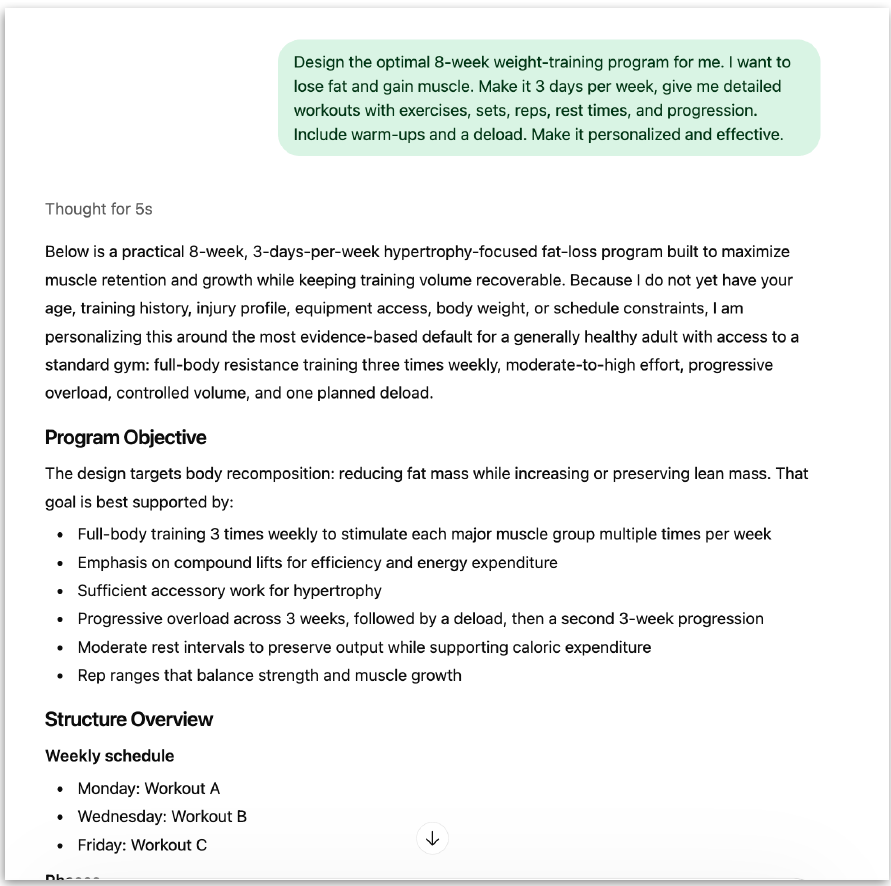
Why not one prompt?

✎ editable — ↑ runs it in ChatGPT
Design the optimal 8-week weight-training program for me. I want to lose fat and gain muscle. Make it 3 days per week, give me detailed workouts with exercises, sets, reps, rest times, and progression. Include warm-ups and a deload. Make it personalized and effective.
What is it missing?
ChatGPT response screenshot
  • Output looks specific but isn’t
  • One prompt cannot fix this.

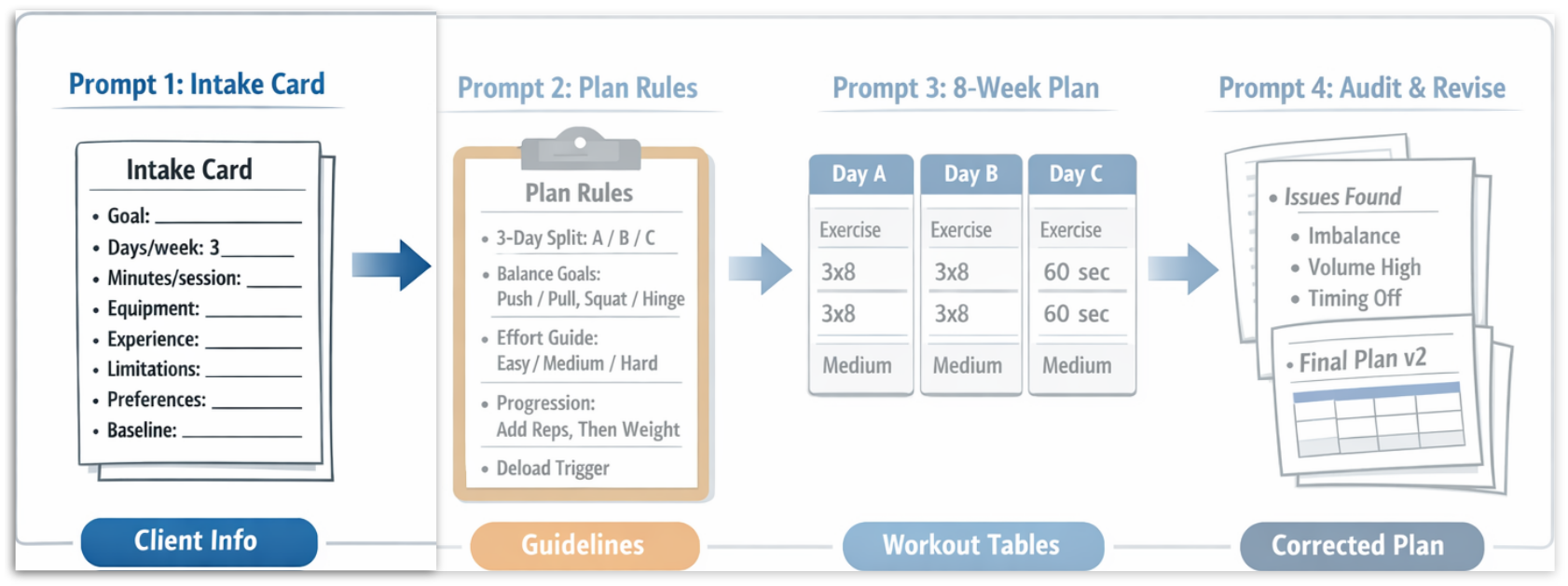
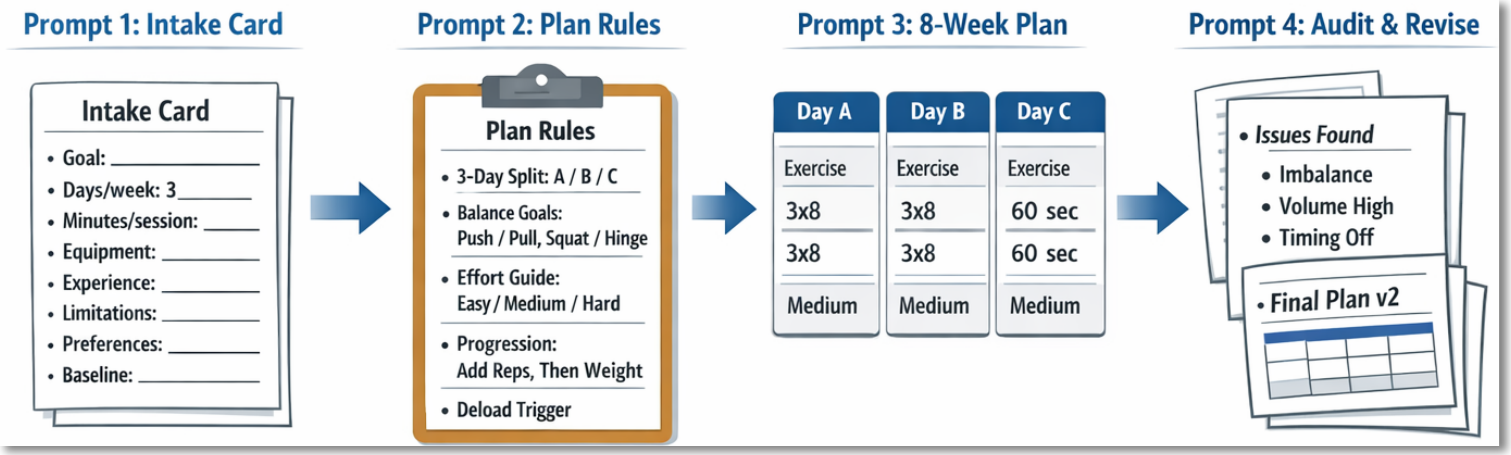
Chain Prompting

  • Break a complex task into smaller prompts
  • Each prompt produces an intermediate “artifact
  • e.g., table, checklist
  • The next prompt uses that artifact as input

Example
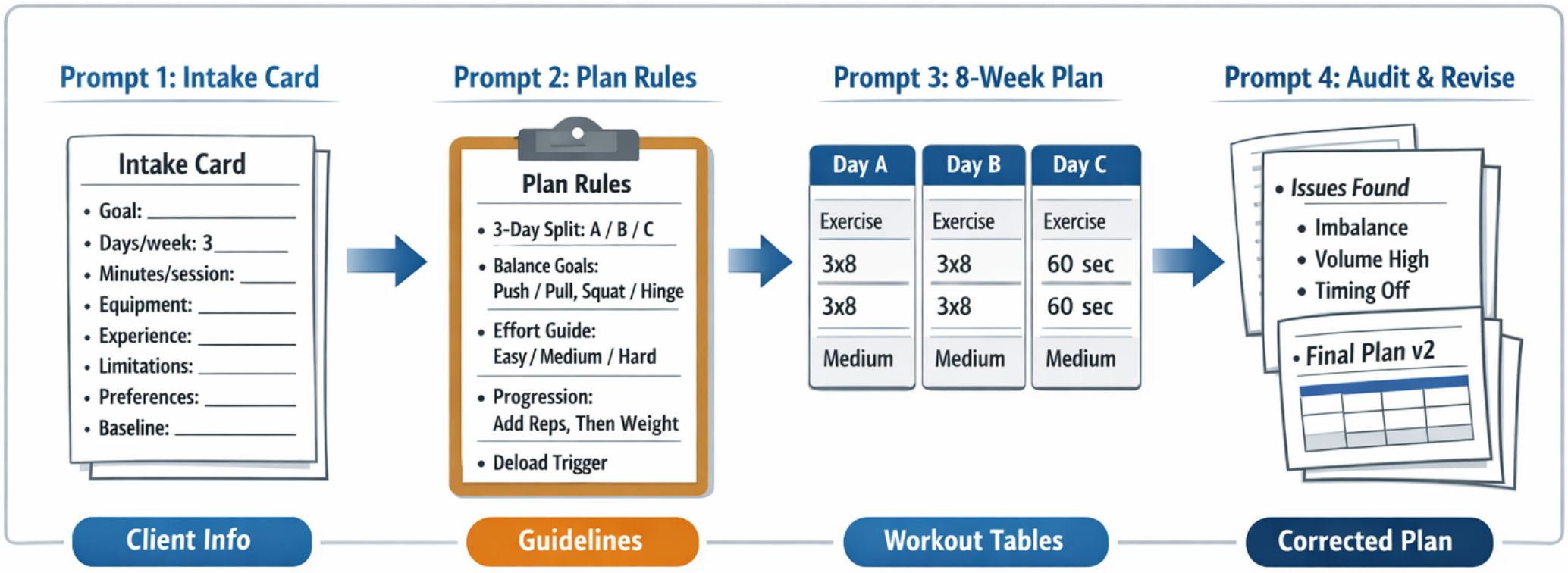
Four-step chain prompting diagram
  • Generate output through a chain of specialized prompts
  • Think of a multi-stage business process
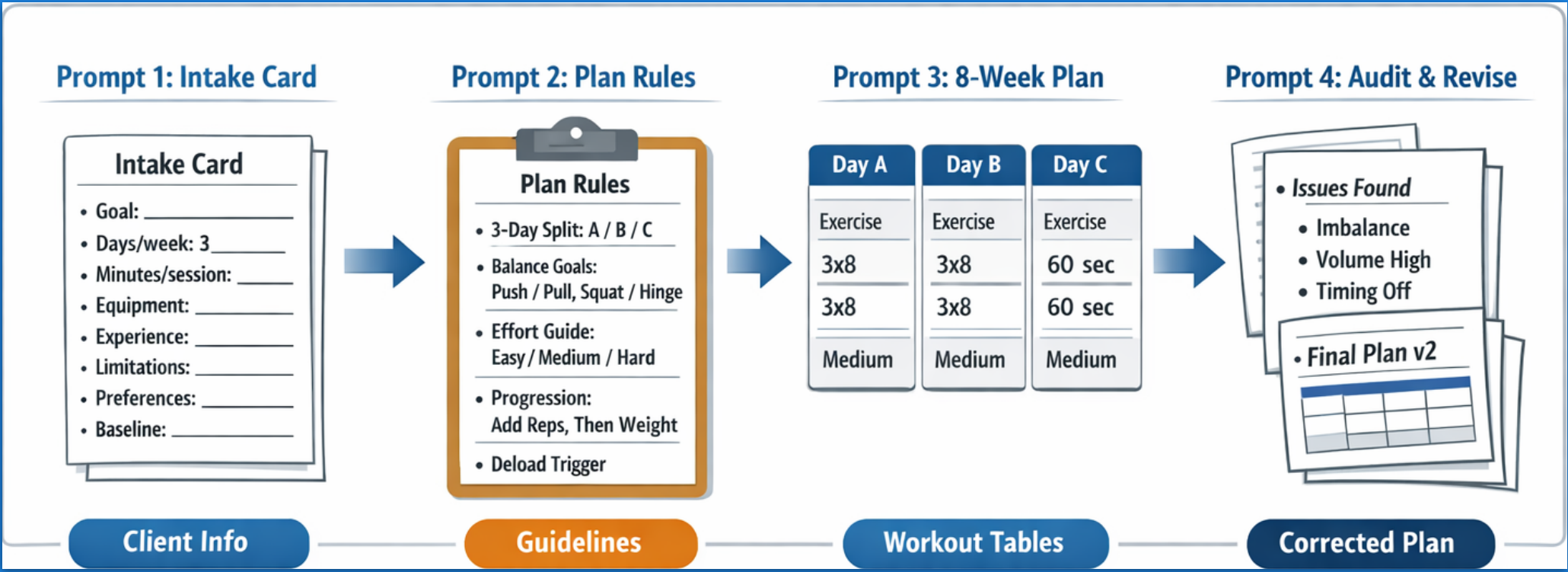
Exercise 2.2
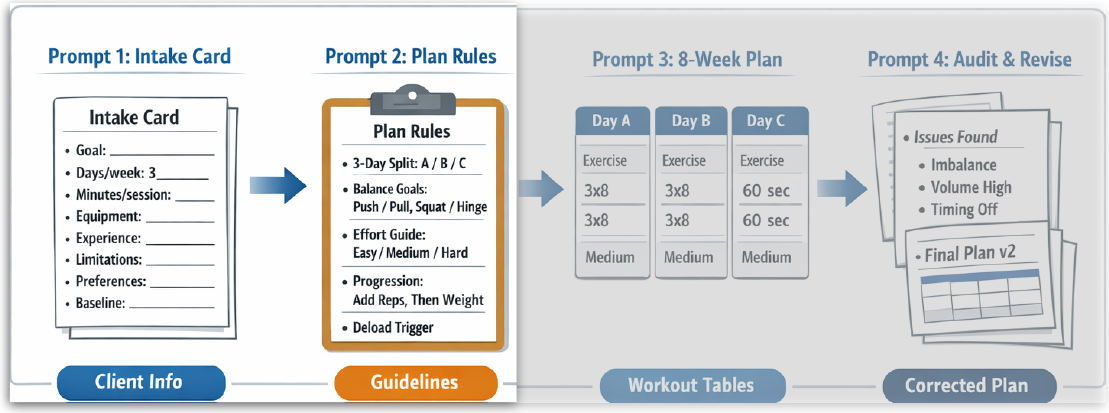
  • Objective: build an 8-week, 3-day weight-training plan using 4 chained prompts
Open Exercise 2.2 →
15:00

Chain Prompting

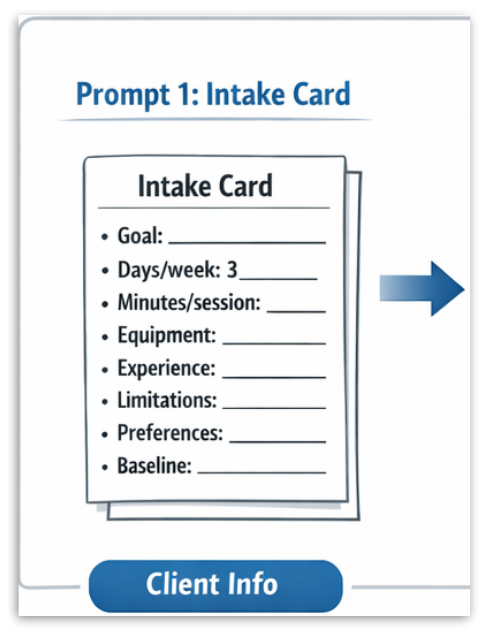
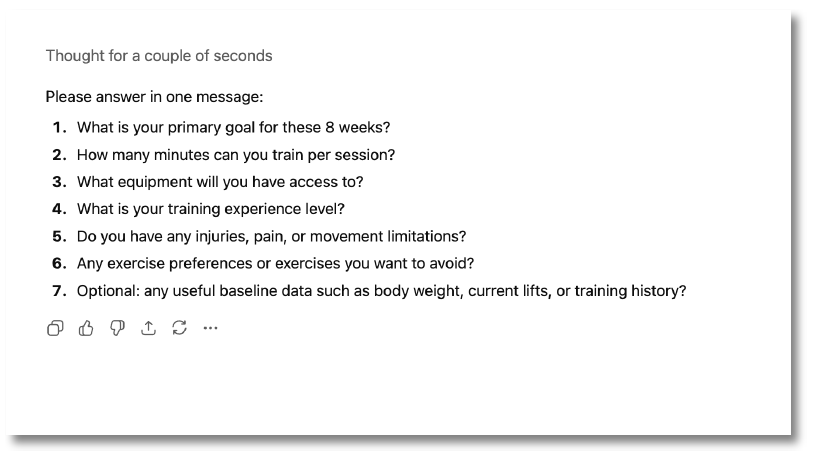
  • Prompt 1 (Intake card)
✎ editable — ↑ runs it in ChatGPT
You are a strength coach. Ask me only the minimum questions needed to design an 8- week weight-training program (3 days/week). After I answer, output an Intake Card with exactly these headings (one line each): Goal; Days/week; Minutes/ session; Equipment; Experience; Limitations; Preferences; Baseline (optional). Do not create the workout yet. Only produce the Intake Card.

Chain Prompting

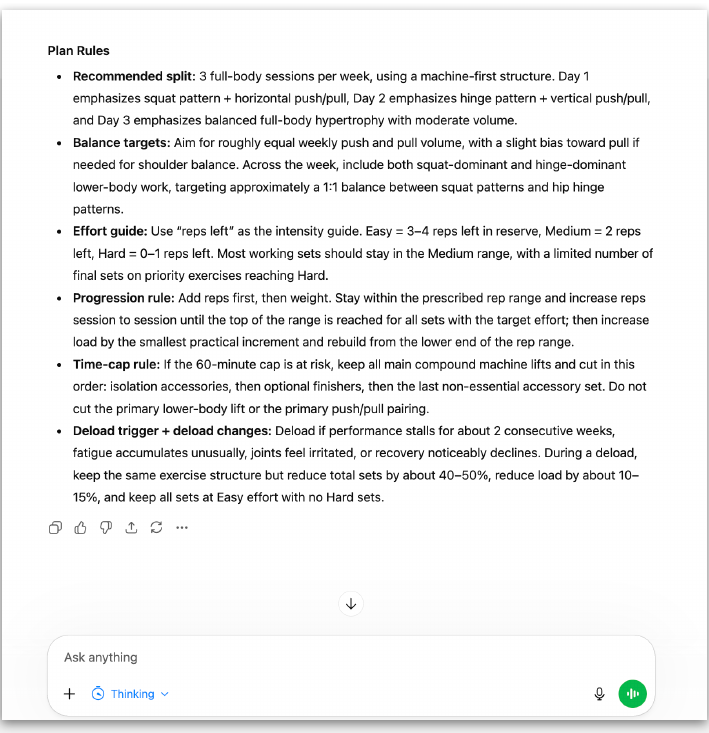
  • Prompt 2: Plan rules
✎ editable — ↑ runs it in ChatGPT
Using the Intake Card above, produce Plan Rules (not the full plan yet). Include 1. Recommended split for 3 days/week 2. Balance targets (push/pull; squat/hinge) 3. Effort guide (Easy/Medium/Hard using "reps left") 4. Progression rule ("add reps then weight") 5. Time-cap rule (what to cut if time runs out) 6. Deload trigger + what to change during deload Output: 6 bullet points titled "Plan Rules."

Chain Prompting

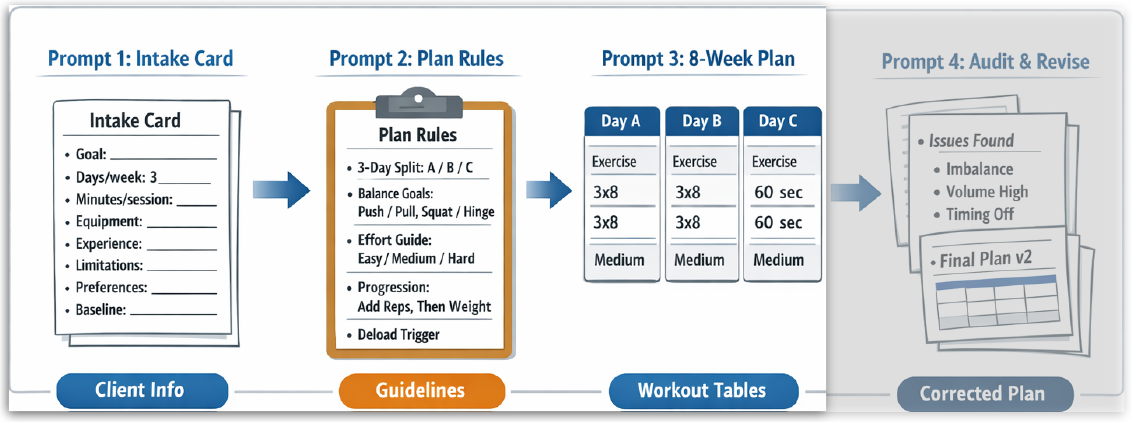
  • Prompt 3: 8-week plan
Four-step chain diagram, step 4 dimmedFour-step chain diagram, all steps colored
Using the Intake Card and Plan Rules above, generate an 8-week, 3-day program.
Output tables for Day A / Day B / Day C. Each line must include: Exercise;
Sets×Reps; Rest; Effort (Easy/Medium/Hard).
Show progression across weeks using the stated progression rule. Keep each
session within the time limit. Include 1-2 substitutions per main lift.
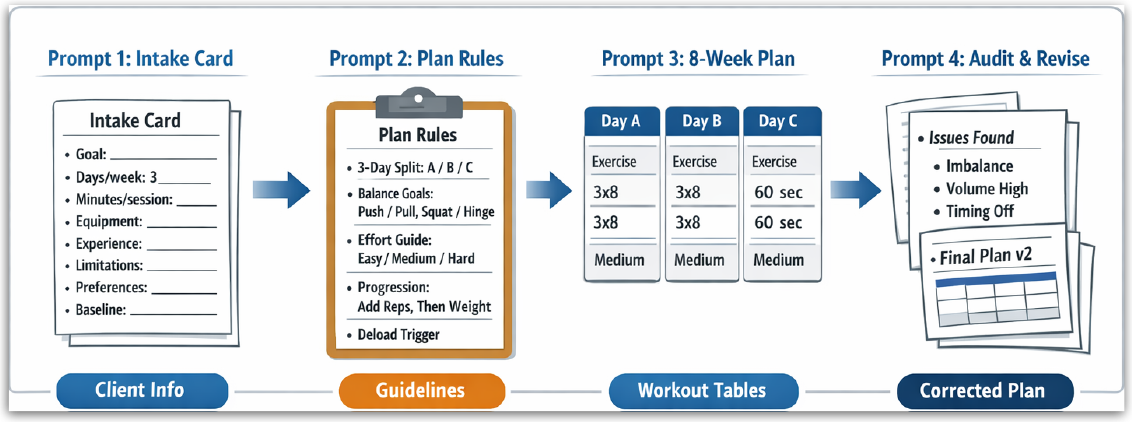
Audit the 8-week plan below using this checklist:
Push/pull balance across the week
Squat/hinge balance across the week
Feasible within minutes/session
Safe given limitations
Progression and deload rules clear and usable
List "Issues Found" as bullets, then output a corrected Final Plan in the same table format.
Plan: [PASTE HERE]

When to chain?

  • Model lacks needed information
  • Task has dependent stages
  • You must review intermediate decisions
  • Quality matters more than speed
Mastering Prompts
  • 1.Prompt Engineering
  • 2.Structure of a prompt
  • 2.1.Task
  • 2.2.Context
  • 2.3.Exemplar, Persona, Format, Tone
  • 2.4.Exercises
  • 3.Improving the prompt: Four-iteration method
  • 4.Advanced Prompting techniques
  • 4.1.Chain Prompting
  • 4.2.Few-shot prompting
  • 4.3.Meta-Prompting
  • 4.4.Self-Critique & Reflection
  • 4.5.ReAct
  • 5.Brainstorm & verify
  • 5.1.The council
  • 5.2.Red-team
  • 5.3.Parallel answers
  • 5.4.Chain-of-verification
  • 5.5.Step back
  • 5.6.AI as judge
  • 5.7.Answer from sources
  • 5.8.Tree of thoughts
  • 5.9.Try, reflect, retry
  • 5.10.Make many, pick one
  • 5.11.Say “I don’t know”
  • 6.Models

Few-shot prompting

  • Goal: cut ambiguity without long instructions
  • Give a few input → output examples
  • Model infers pattern: task, format, tone, criteria

Few-shot prompting

  • Goal: cut ambiguity without long instructions
  • Give a few input → output examples
  • Model infers pattern: task, format, tone, criteria
Zero-shot prompt
Few-shot prompt
TaskCopyedit this email…
TaskSummarize my emails
by doing X & Y
Example 1Example 1 of input-
output email
Example 2Example 2 of input-
output email
Your inputYour current email

Example

You are an assistant that rewrites customer support replies in our company’s voice. Rewrite the draft reply below. Example 1: Draft: "I’m really sorry about this issue. I totally understand your frustration, and I want you to know that we take this very seriously. I’ve escalated your case to our technical team and they should be looking into it shortly. Please don’t hesitate to reach out if you need anything else." Rewritten: "Sorry about this. Not the experience we want for you. I’ve flagged it with our technical team; you’ll hear back within 24 hours. Hit reply if anything else comes up." Example 2: Draft: "Thank you for contacting us regarding your subscription renewal. I have reviewed your account and I can confirm that your renewal has been processed successfully. Your new billing cycle will begin on June 1st. If you have any further questions, please feel free to contact us at any time." Rewritten: "All set: your renewal went through and the next billing cycle starts June 1. Let me know if anything looks off." Now rewrite this: Draft: "[PASTE HERE]"
  • Save reusable examples from real work
  • Reuse whenever the draft changes
Mastering Prompts
  • 1.Prompt Engineering
  • 2.Structure of a prompt
  • 2.1.Task
  • 2.2.Context
  • 2.3.Exemplar, Persona, Format, Tone
  • 2.4.Exercises
  • 3.Improving the prompt: Four-iteration method
  • 4.Advanced Prompting techniques
  • 4.1.Chain Prompting
  • 4.2.Few-shot prompting
  • 4.3.Meta-Prompting
  • 4.4.Self-Critique & Reflection
  • 4.5.ReAct
  • 5.Brainstorm & verify
  • 5.1.The council
  • 5.2.Red-team
  • 5.3.Parallel answers
  • 5.4.Chain-of-verification
  • 5.5.Step back
  • 5.6.AI as judge
  • 5.7.Answer from sources
  • 5.8.Tree of thoughts
  • 5.9.Try, reflect, retry
  • 5.10.Make many, pick one
  • 5.11.Say “I don’t know”
  • 6.Models

Meta-Prompting

Describe the outcome; let the model design the prompt
Why?
The model knows what it needs
You get something reusable

Meta-prompt pattern

Three parts
Task and audience
Format and constraints
Requests

Meta-prompt pattern

Task & audience
Format & constraints
Ask model to produce:
1.Prompt template
2.Required input
3.Quality checklist
Meta-prompt
Task & audience
Format-constraints
Requests

Example

  • Scenario: You're a manager. Every Friday you post a short LinkedIn
    update on a team win that week. You want a reusable prompt you can
    fill in each Friday in 30 seconds.

Example

I need a reusable ChatGPT prompt template for writing a short LinkedIn post that highlights a weekly team accomplishment.

Requirements:

  • The template must ask the user to fill in: what the team accomplished, who was involved, and why it matters.
  • Output should be a LinkedIn post, 3—5 sentences, professional but not stiff.
  • Should feel authentic, not AI-written.
  • End with a takeaway or lesson, not a question begging for engagement.

Output:

  1. A ready-to-use prompt template with clearly marked fill-in fields
  2. The list of required inputs
  3. A quality checklist to verify the post

Exercise 2.3

Write a meta-prompt that asks ChatGPT to build a prompt template
for out-of-office email replies. Then test it. Fill in the template
and see if the output is something you'd actually use.
Open Exercise 2.3 →
10:00
Mastering Prompts
  • 1.Prompt Engineering
  • 2.Structure of a prompt
  • 2.1.Task
  • 2.2.Context
  • 2.3.Exemplar, Persona, Format, Tone
  • 2.4.Exercises
  • 3.Improving the prompt: Four-iteration method
  • 4.Advanced Prompting techniques
  • 4.1.Chain Prompting
  • 4.2.Few-shot prompting
  • 4.3.Meta-Prompting
  • 4.4.Self-Critique & Reflection
  • 4.5.ReAct
  • 5.Brainstorm & verify
  • 5.1.The council
  • 5.2.Red-team
  • 5.3.Parallel answers
  • 5.4.Chain-of-verification
  • 5.5.Step back
  • 5.6.AI as judge
  • 5.7.Answer from sources
  • 5.8.Tree of thoughts
  • 5.9.Try, reflect, retry
  • 5.10.Make many, pick one
  • 5.11.Say “I don’t know”
  • 6.Models

Self-critique and reflection

Problem: ChatGPT's first answer is a first draft.
Wrong in ways that are hard to spot,
because it sounds good.
Two fixes:
Self-critique
Reflection
Self critique: Write first,
then check, then revise
Reflection: Think first,
then write
One looks backward, the
other forward

Self-critique

Draft → Grade → Revise
How it works:
Model produces draft
Grades itself against a checklist
Flags issues
Produces revised version

Example

Write a one-paragraph promo bio about  McGill University for
prospective students

After writing, self-critique using this checklist:

Under 80 words

States what we do, who we serve, and where we're based

Avoids generic filler ("passionate team," "innovative solutions,"
"world-class")?

Would a prospective student learn something specific from reading
this?

List issues found, then revise once. Output only the final version.

Self-critique

  • Think → Then Write
  • How it works:
    • Before producing output, the model states what it's assuming
    • It surfaces what's missing or ambiguous
    • Asks you clarifying questions or picks reasonable defaults
    • Produces the output

Differences

Self-critique: Check the product
Produces revision
Reflection: Check the thinking
Improves before generating output
Use both when stakes are high or constraints are tight

Example

Write a one-paragraph promo bio about McGill University for prospective students.

Step 1 — Reflect: Before writing, state your assumptions about the audience, the tone you're choosing, and what information you wish you had. Three to four lines.

Step 2 — Draft: Write the bio.

Step 3 — Self-critique:

  • Under 80 words?
  • Free of generic clichés?
  • At least one detail specific to McGill?
  • Would a 17-year-old find it useful?

List issues, revise once, output only the final version.

Mastering Prompts
  • 1.Prompt Engineering
  • 2.Structure of a prompt
  • 2.1.Task
  • 2.2.Context
  • 2.3.Exemplar, Persona, Format, Tone
  • 2.4.Exercises
  • 3.Improving the prompt: Four-iteration method
  • 4.Advanced Prompting techniques
  • 4.1.Chain Prompting
  • 4.2.Few-shot prompting
  • 4.3.Meta-Prompting
  • 4.4.Self-Critique & Reflection
  • 4.5.ReAct
  • 5.Brainstorm & verify
  • 5.1.The council
  • 5.2.Red-team
  • 5.3.Parallel answers
  • 5.4.Chain-of-verification
  • 5.5.Step back
  • 5.6.AI as judge
  • 5.7.Answer from sources
  • 5.8.Tree of thoughts
  • 5.9.Try, reflect, retry
  • 5.10.Make many, pick one
  • 5.11.Say “I don’t know”
  • 6.Models

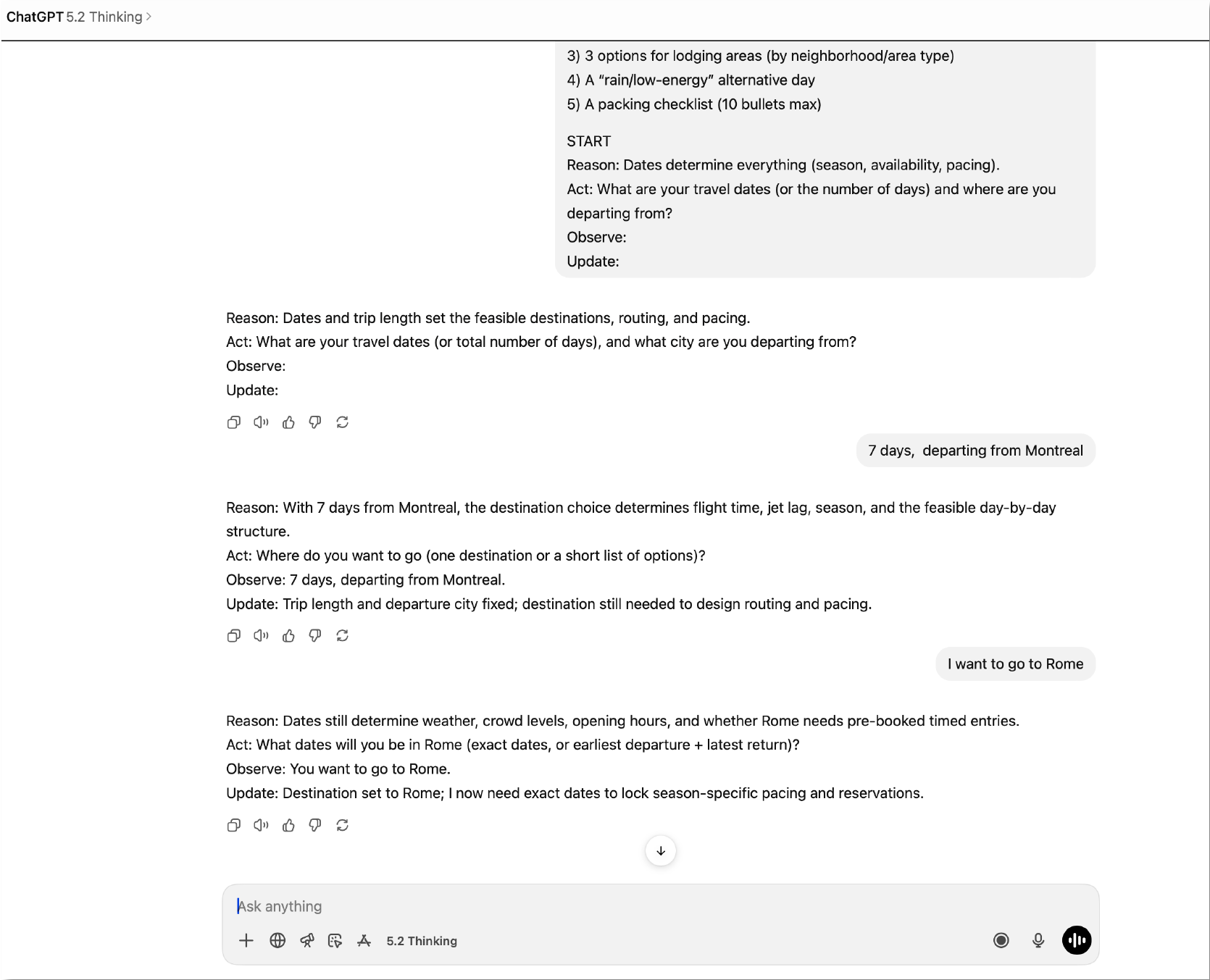
ReAct prompting

  • Pattern: Reason → Act → Observe → Update → repeat
  • Purpose: Solve tasks by iterating with evidence, not guessing
  • Best for: messy problems + missing info + tool use

ReAct: the loop

  • Reason: what’s missing / what’s next
  • Act: ask a question or use a tool (search, calc, docs)
  • Observe: capture what you learned
  • Update: revise the plan and continue

Example

You are a travel planner that uses the ReAct loop: Reason → Act → Observe → Update.
Goal: Plan my vacation itinerary.
RULES
Ask only ONE question at a time.
Do not invent facts (no assuming budget, dates, or interests).
Keep each turn short.
Use this exact format every turn:
Reason: <what you need next to plan well>
Act: <one question>
Observe: <fill after I answer in 1 line>
Update: <how the plan changes in 1 line>
Stop Condition: When you have enough info, output ONLY:
1.Trip summary (destination(s), dates, budget level)
2.Day-by-day itinerary (AM / PM / Evening)
3.3 options for lodging areas (by neighborhood/area type)
4.A “rain/low-energy” alternative day
5.A packing checklist (10 bullets max)
START
Reason: Dates determine everything (season, availability, pacing).
Act: What are your travel dates (or the number of days) and where are you departing from?

Example

Exercise 2.4

Write a ReAct prompt to pick a restaurant for a team dinner tonight. Test it: answer the questions and see if you'd actually book the recommendation.
Open Exercise 2.4 →
10:00
Mastering Prompts
  • 1.Prompt Engineering
  • 2.Structure of a prompt
  • 2.1.Task
  • 2.2.Context
  • 2.3.Exemplar, Persona, Format, Tone
  • 2.4.Exercises
  • 3.Improving the prompt: Four-iteration method
  • 4.Advanced Prompting techniques
  • 4.1.Chain Prompting
  • 4.2.Few-shot prompting
  • 4.3.Meta-Prompting
  • 4.4.Self-Critique & Reflection
  • 4.5.ReAct
  • 5.Brainstorm & verify
  • 5.1.The council
  • 5.2.Red-team
  • 5.3.Parallel answers
  • 5.4.Chain-of-verification
  • 5.5.Step back
  • 5.6.AI as judge
  • 5.7.Answer from sources
  • 5.8.Tree of thoughts
  • 5.9.Try, reflect, retry
  • 5.10.Make many, pick one
  • 5.11.Say “I don’t know”
  • 6.Models

Beyond one prompt

  • One prompt is one guess — the best answers come from running the model like a team.
  • Generate more and combine, or attack the answer until the weak claims fall away.
  • These methods raise quality and cut hallucination.

5.1 The council

  • Ask several 'experts' to answer the same question
  • They critique each other, then a chair merges the best
  • Disagreement surfaces blind spots one voice would miss
Your promptdebate & mergeOne answer

5.1 The council

A manager choosing between two logistics vendors:
✎ editable — ↑ runs it in ChatGPT
I'm deciding between two logistics vendors: Vendor A is cheaper but newer, Vendor B is pricier with a long track record. Answer this three times, each as a different expert who does not see the others: first a cost-focused CFO, then a risk-and-continuity operations chief, then a customer-experience lead. Have each give a recommendation with reasons. Then, as a neutral chair, note where they disagree, name the blind spots each one has, and merge their views into one recommendation with the key trade-offs spelled out.
Three distinct takes, an explicit map of where they clash, and one merged call that names the trade-offs instead of hiding them.

5.1 Try it — The council

Convene a council to pressure-test a decision from three angles, then merge.
✎ editable — ↑ runs it in ChatGPT
We're about to raise our subscription price by 15% next quarter. Answer this three times, each as a different expert who cannot see the others: first a growth-focused head of sales, then a customer-retention lead, then a brand and reputation advisor. Have each give a clear position with reasons. Then, as a neutral chair, show where they disagree, call out each one's blind spot, and merge them into a single recommendation with the main risks listed.
10:00

5.2 Red-team the answer

  • Tell the model to attack its own answer
  • Assume it's wrong; hunt for specific weak spots
  • Then check those spots and correct them
First answercost?risk?gap?Corrected answerassume wrong, hunt the holes

5.2 Red-team the answer

A manager reviewing a market-entry recommendation before it goes to the board:
✎ editable — ↑ runs it in ChatGPT
Red-team this recommendation to enter the German market next quarter. Pretend you produced it, then switch sides and attack it as a hostile reviewer. Assume it's wrong. List the three most likely ways it fails — hidden costs, demand assumptions, regulatory or timing risks. For each, say what evidence would confirm the flaw and check whether the argument really holds. Then give a corrected recommendation — or, if it can't be saved, say so and why.
A recommendation stress-tested against its own weakest points, with the shaky assumptions flagged instead of buried.

5.2 Try it — Red-team the answer

Make the model red-team its own answer, then correct it.
✎ editable — ↑ runs it in ChatGPT
Red-team this shortlist ranking three candidates for the head-of-sales role. Pretend you produced it, then argue against your own top pick as a hostile reviewer. Assume you chose wrong. Name the strongest reasons this person underperforms in year one, say what in their record would confirm each risk, and test whether the ranking holds. Then give a revised ranking — or explain why the original still wins.
10:00

5.3 Parallel answers

  • Ask the same question a few times over
  • Watch which points show up every time
  • Recurring points are the safer bet — not proof
Same promptAnswerAnswerAnswerkeep what recurs

5.3 Parallel answers

A finance lead sizing the risk in a new market entry:
✎ editable — ↑ runs it in ChatGPT
We're considering opening our first office in Brazil next year. List the three biggest risks to a successful launch, in order of importance, with one sentence on each. Give me your honest independent take — don't hedge.
Run it in three fresh chats. If currency and regulatory risk surface every time, they deserve real attention. A risk that appears once is worth a second look, not a headline.

5.3 Try it — Parallel answers

Run this in 3 separate chats, then keep only what repeats.
✎ editable — ↑ runs it in ChatGPT
What are the three biggest risks to hitting our sales target this quarter? Rank them by how likely each one is, one sentence each. Give me your honest independent read — don’t hedge.
10:00

5.4 Chain-of-verification

  • Model drafts, then interrogates its own claims
  • It writes fact-check questions, answers each, revises
  • Catches shaky facts before they reach you
Draft answerVerification questionsIs the figure right?Does the source say it?Any claim unchecked?Revised answer

5.4 Chain-of-verification

A director sanity-checking a market summary before it goes to the board:
✎ editable — ↑ runs it in ChatGPT
Write a one-page summary of the meal-kit delivery market: top three players, their rough revenue, and growth trend. Then, before you finish, list every factual claim you made as a numbered verification question. Answer each question one at a time, flagging anything you're not confident about or can't confirm. Finally, rewrite the summary correcting or removing any claim that failed its check, and mark which numbers I should independently confirm against a real source.
A cleaner summary where dubious figures are flagged or cut, not stated as fact.

5.4 Try it — Chain-of-verification

Make the model fact-check its own draft before you trust it.
✎ editable — ↑ runs it in ChatGPT
Draft a short profile of a candidate for our VP of Sales role based on the background I describe: 12 years in enterprise software sales, led a team of 40, grew a region from $10M to $45M. Then list each specific claim and assumption in your draft as a verification question, answer them one by one, and note which ones you inferred versus what I actually told you. Rewrite the profile so it only states what's supported, and separate out the parts I'd need to confirm in an interview.
10:00

5.5 Step back first

  • Ask for the general principle before the specific answer
  • The big picture guides a sharper, less error-prone reply
  • Best for hard, judgment-heavy questions
The questionTheprinciplestep backBetter answer

5.5 Step back first

A VP deciding how to price a new product tier:
✎ editable — ↑ runs it in ChatGPT
Before you answer, first step back and lay out the general principles of how to price a new premium tier when it sits alongside an existing mid-tier product. Then apply those principles to my case: our mid-tier software is $40/month, customers say the premium features are "nice to have," and our top competitor charges $75 for a similar premium plan. Recommend a price and explain how it follows from the principles.
A grounded recommendation anchored in pricing logic (anchoring, cannibalization, willingness-to-pay), not a number pulled from thin air.

5.5 Try it — Step back first

Make the model state the principle before it answers your question.
✎ editable — ↑ runs it in ChatGPT
Before you answer, first step back and describe the general principles of when a company should build a capability in-house versus outsource it. Then apply those principles to my decision: we're a 60-person marketing agency deciding whether to hire an in-house data analyst or keep using a freelance contractor we pay roughly $3,000 a month. Give me a recommendation that follows from the principles.
10:00

5.6 AI as judge

  • Have the AI grade options against a clear rubric
  • It scores each, explains, then picks a winner
  • Turns vague comparison into a defensible call
Draft ADraft Bjudgescore each on your rubricWinner

5.6 AI as judge

A manager comparing two shortlisted vendor proposals:
✎ editable — ↑ runs it in ChatGPT
Act as a neutral evaluator. Score these two logistics vendor proposals against four criteria, weighted equally: price transparency, delivery guarantees, references, and contract flexibility. For each criterion, give each vendor a 1-5 score and one sentence explaining why. Then total the scores and name the winner. Judge only on what the proposals actually say, not on length or polish. Proposal A: [paste]. Proposal B: [paste].
A scored rubric with per-criterion reasoning and a defensible winner, not a vague "both look fine."

5.6 Try it — AI as judge

Ask the AI to judge two candidate messages against a rubric.
✎ editable — ↑ runs it in ChatGPT
Act as a neutral judge. Score these two draft layoff-announcement emails against three criteria: clarity, empathy, and legal caution. Give each a 1-5 score per criterion with one sentence of reasoning, total them, and pick the stronger draft. Judge on substance, not length. Draft 1: We are reducing headcount effective Friday; HR will contact affected staff. Draft 2: This was a hard decision. Roles are being eliminated; we will support each person through the transition and HR reaches out this week.
10:00

5.7 Answer only from sources

  • Paste your own documents into the chat.
  • Tell it to answer only from them.
  • Make it quote the exact passage.
Your documentonly from hereanswer + exact quotecited from the source

5.7 Answer only from sources

A manager checking what a signed vendor contract actually commits them to:
✎ editable — ↑ runs it in ChatGPT
I've pasted our full service agreement with Northwind Logistics below. Answer these three questions using ONLY this document: What is the exact notice period to cancel? Are there any auto-renewal terms? What penalties apply for late payment? For each answer, quote the exact sentence and clause number you used. If the contract does not cover a question, say "not in the document" instead of guessing.
Three answers, each backed by a quoted clause, and an honest "not in the document" where the contract is silent, instead of a confident guess.

5.7 Try it — Answer only from sources

Paste a document and force answers grounded only in it.
✎ editable — ↑ runs it in ChatGPT
Below is our Q3 employee engagement survey report. Answer only from this document: Which department scored lowest on "manager support," and what was the score? What are the top two reasons employees gave for considering leaving? Quote the exact line and page for each answer. If something isn't covered in the report, reply "not in the document" rather than estimating.
10:00

5.8 Tree of thoughts

  • Ask for 3 different strategies, not one
  • Have it score each on your criteria
  • Then build out the strongest one
ProblemOption AOption BOption Cscore each, grow the bestFull plan

5.8 Tree of thoughts

A retailer deciding how to handle a supplier that keeps missing delivery dates:
✎ editable — ↑ runs it in ChatGPT
Our main packaging supplier has missed delivery dates three quarters in a row, but their pricing is 15% below anyone else and switching would take months. Sketch three genuinely different ways to handle this: for example renegotiating the contract with penalties, dual-sourcing with a backup supplier, or bringing part of the work in-house. For each, give the upside, the main risk, and rough cost and time to set up. Then score each out of 10 on reliability, cost, and speed to fix, pick the strongest, and build it into a concrete 90-day plan.
Three real options compared side by side, then one fully worked plan — instead of the first fix it happened to reach for.

5.8 Try it — Tree of thoughts

Ask for three approaches, scored, then the best one developed.
✎ editable — ↑ runs it in ChatGPT
We need to lift attendance at our monthly all-hands, which has dropped to under 40% of staff. Sketch three genuinely different approaches: for example changing the format and length, changing the timing and making it optional, or replacing it with something else entirely. For each, give the upside, the main risk, and what it would take to try. Then score each out of 10 on likely attendance, effort, and staff goodwill, pick the strongest, and turn it into a plan we could run next month.
10:00

5.9 Try, reflect, retry

  • Model drafts, sees what missed, tries again
  • Each retry carries a short lesson forward
  • Needs real feedback, not just re-guessing
DraftReflectRetrylessonwhat missed?

5.9 Try, reflect, retry

A director drafting a customer apology email after a service outage:
✎ editable — ↑ runs it in ChatGPT
Draft an apology email to customers about our 6-hour payment outage yesterday. Then review your own draft against these three tests: (1) Does it say clearly what happened without jargon? (2) Does it offer something concrete, not just "sorry"? (3) Would an angry customer feel heard? Write one line on what your draft missed, then rewrite it fixing those gaps.
A second draft that fixes its own weak spots — plain language, a real gesture, a warmer tone — because you gave it clear tests to grade against.

5.9 Try it — Try, reflect, retry

Have the model draft, critique itself against your criteria, then retry
✎ editable — ↑ runs it in ChatGPT
Write a job description for a mid-level operations manager at our logistics company. Then check your draft against these tests: Is it specific to logistics, not generic? Does it list must-have skills separately from nice-to-haves? Would a strong candidate find it appealing? Note in one line what the draft missed, then rewrite it fixing those gaps.
10:00

5.10 Make many, pick one

  • Ask for several full versions at once
  • Judge them against clear criteria, keep the best
  • Great for creative, one-off pieces
Ask for manyv1v2v3v4v5judge on your criteriaThe best one

5.10 Make many, pick one

A marketing lead writing a product-launch email:
✎ editable — ↑ runs it in ChatGPT
Write 6 different subject lines for our launch email announcing a new expense-tracking tool to small-business owners. Vary the angle: some benefit-led, some curiosity-led, some plain. Then judge all 6 against these criteria: clear value, under 50 characters, no hype words, and would make a busy owner open it. Pick the single best one, explain why it won, and name the runner-up.
Six real options plus a reasoned winner, instead of one safe line you have to second-guess.

5.10 Try it — Make many, pick one

Generate several versions and have the model pick the best against your criteria.
✎ editable — ↑ runs it in ChatGPT
Write 5 different opening paragraphs for a memo telling staff we're moving to a hybrid three-days-in-office policy. Vary the tone: some warm, some direct, some reassuring. Then judge all 5 against these criteria: acknowledges the change honestly, sounds human not corporate, under 60 words, and lands the reason clearly. Pick the best one, explain why, and flag any that felt tone-deaf.
10:00

5.11 Let it say "I don't know"

  • Give the model explicit permission to abstain.
  • Ask it to rate its confidence on each answer.
  • Fewer confident guesses on facts it lacks.
Questionsure?yesnoAnswer“not sure”no confident guessing

5.11 Let it say "I don't know"

A consultant sizing a market before a pitch:
✎ editable — ↑ runs it in ChatGPT
I’m sizing the market for premium pet insurance in Canada. Give me the number of households with pets, the current market size in dollars, and the fastest-growing segment. For anything you’re not sure of, say “I’m not certain” instead of estimating — and rate each figure high, medium, or low confidence, noting if it may be out of date. Don’t invent precise numbers just to sound authoritative.
Honest figures where it has them, and an explicit “not sure” where it doesn’t — instead of confident numbers that could embarrass you in the room.

5.11 Try it — Let it say "I don't know"

Add permission to abstain and a confidence rating to a factual question.
✎ editable — ↑ runs it in ChatGPT
I'm preparing a board slide on our top competitor. Tell me: the year they were founded, their current CEO, and their most recent annual revenue. If you are not certain of any figure, say "I'm not sure" instead of guessing — a wrong number in front of the board is worse than a gap. For each item, give a confidence level (high / medium / low) and note whether it may be out of date.
10:00
Mastering Prompts
  • 1.Prompt Engineering
  • 2.Structure of a prompt
  • 2.1.Task
  • 2.2.Context
  • 2.3.Exemplar, Persona, Format, Tone
  • 2.4.Exercises
  • 3.Improving the prompt: Four-iteration method
  • 4.Advanced Prompting techniques
  • 4.1.Chain Prompting
  • 4.2.Few-shot prompting
  • 4.3.Meta-Prompting
  • 4.4.Self-Critique & Reflection
  • 4.5.ReAct
  • 5.Brainstorm & verify
  • 5.1.The council
  • 5.2.Red-team
  • 5.3.Parallel answers
  • 5.4.Chain-of-verification
  • 5.5.Step back
  • 5.6.AI as judge
  • 5.7.Answer from sources
  • 5.8.Tree of thoughts
  • 5.9.Try, reflect, retry
  • 5.10.Make many, pick one
  • 5.11.Say “I don’t know”
  • 6.Models

GPT-5.6 Luna

  • Fast and affordable
  • Best for simple, high-frequency tasks
  • $1 input / $6 output per 1M tokens
  • Analogy: Swiss Army knife — fast, does it all well

GPT-5.6 Terra

Balanced for everyday professional work
  • Roughly 2x cheaper than GPT-5.5-class: $2.50 input / $15 output per 1M tokens
  • Free & Go users get Terra only
  • Analogy: Intern with great reflexes — fast, not deep

GPT-5.6 Sol

  • Flagship — $5 input / $30 output per 1M tokens
  • Deepest reasoning
  • Slowest and priciest; for Plus, Pro, Business, Enterprise
  • Only tier with max reasoning effort + ultra mode
  • Analogy: PhD professor — slower, deeper
Mastering Prompts
  • 1.Prompt Engineering
  • 2.Structure of a prompt
  • 2.1.Task
  • 2.2.Context
  • 2.3.Exemplar, Persona, Format, Tone
  • 2.4.Exercises
  • 3.Improving the prompt: Four-iteration method
  • 4.Advanced Prompting techniques
  • 4.1.Chain Prompting
  • 4.2.Few-shot prompting
  • 4.3.Meta-Prompting
  • 4.4.Self-Critique & Reflection
  • 4.5.ReAct
  • 5.Institutionalizing a prompt
  • 6.Models
  • 7.Personalizing GPT

GPT-5.6 Luna

  • Fast and affordable
  • Best for simple, high-frequency tasks
  • $1 input / $6 output per 1M tokens
  • Analogy: Swiss Army knife — fast, does it all well

GPT-5.6 Terra

  • Balanced for everyday professional work
  • Roughly 2x cheaper than GPT-5.5-class: $2.50 input / $15 output per 1M tokens
  • Free & Go users get Terra only
  • Analogy: Intern with great reflexes — fast and focused, not deep

GPT-5.6 Sol

  • Deepest reasoning
  • Flagship — $5 input / $30 output per 1M tokens
  • Slowest and priciest; Plus, Pro, Business, and Enterprise only
  • Only tier with max reasoning effort and ultra mode
  • Analogy: PhD professor — slower replies, deeper thinking

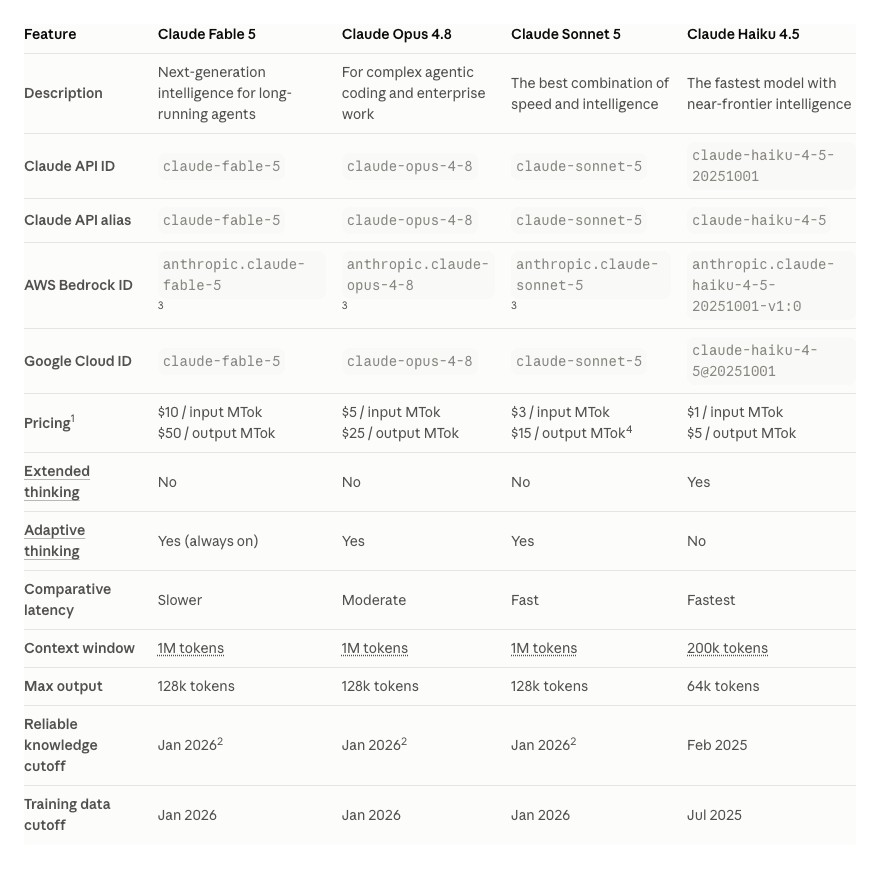
Claude models
Claude model comparison

Sol ↔ Fable 5 · Terra ↔ Sonnet 5 · Luna ↔ Haiku 4.5 — and Opus 4.8 is the coding specialist.

Click or → to advance · E exercises · F fullscreen · O overview

Sections

Lecture 2 — Mastering Prompts